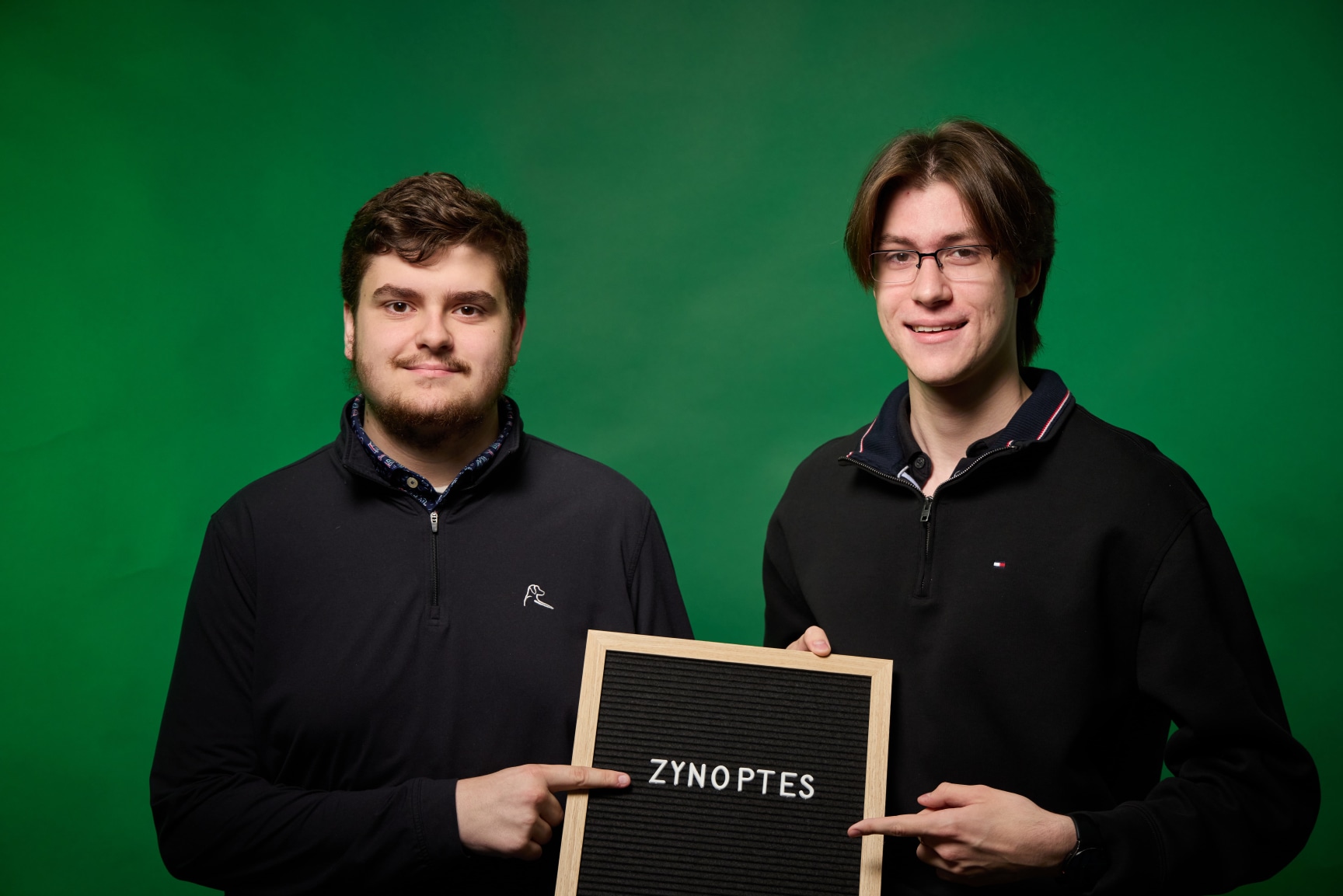


Hi, we are Owen and Max, the founders of Zynoptes.
Overview
A robotics team can hand-build a few dozen test scenarios before shipping. The robot will face thousands in the field. Zynoptes closes that gap by writing and running simulations autonomously, so teams find failures before a customer pilot and ship with confidence.
Ask: Intros to CTOs at Seed to Series A robotics companies with a robot in pilots or production, and to seed investors writing $1M+ into robotics. Reach us at owen@zynoptes.com.
The problem
Robotics startups are selling into a $42 billion industrial market, up 11% from last year, but still validate robots with testing that scales at human speed. A single robot faces thousands of combinations of objects, environments, sensor conditions, and timing, while teams can hand-build only a fraction before deployment. The failures that slip through surface on hardware or in customer pilots, where they are most expensive to fix.
Existing simulation replays expected scenarios. It rarely explores complex combinations, or catches semantic failures where the robot reports success while doing the wrong thing.
Building environments, test cases, and evaluation logic is manual work, pulling scarce robotics engineers off the product.
Reproducing a failure means recreating interacting perception, planning, control, ROS, and sensor conditions, then rerunning enough variations to know whether the fix generalizes. Pilots slip while that happens.
Our solution
Zynoptes is an autonomous simulation engineer for robotics. It builds an initial high-fidelity simulation alongside your engineers, then generates and runs it through every combination the field will throw at it. When it finds a semantic or code failure, it proposes a fix and validates it before anything reaches hardware.
Zynoptes ingests the simulator and robot codebase teams already use, then creates scenarios across environments, objects, sensor conditions, timing, and edge cases.
It catches conventional code failures and semantic failures where the robot reports success while doing the wrong thing, with replays and evidence for every finding.
It diagnoses root causes, suggests code changes, and re-tests across the scenario matrix so teams can verify a fix generalizes before deployment.
Build your simulation
Describe your robot and the task you want it to perform. Zynoptes helps your engineering team build and refine a working simulation in Gazebo or Isaac Sim, using your assets and agreed requirements.
Find hidden failures
Test your robot software across changing layouts, payloads and operating conditions. Zynoptes runs cloud simulation campaigns within your scope and budget, uncovering failures a single demo misses.
Validate your fixes
Turn a reproduced failure into a software or configuration fix your engineers can review. Zynoptes tests repairs against separate validation scenarios and delivers a patch you approve, with evidence.
Vision
Every mature software stack eventually develops a continuous testing layer, and AI is making that layer faster and broader. Software teams generate and run thousands of test cases in minutes, while robotics teams hand-build a few simulations and discover the rest during physical pilots. With Zynoptes, simulation becomes the default reliability layer for robotics, the way CI is for software: same robot stack, same customer environment, every possible scenario generated, every fix validated before hardware reaches the field.
Team
Owen Bales (CEO): Co-founded a tech consulting startup and scaled it to $100k ARR. AI researcher and CS graduate from Harvard. He has watched engineering time disappear into diagnosing complex systems after they fail, and built Zynoptes to catch those failures in simulation instead.
Max Kern (CTO): Built a distributed pipeline for 26 million pages of congressional records, cutting processing from 126 days to 13 hours. Trained an ML model on that data to predict the characteristics of congressional nominees before nomination. Studied CS and Economics at Harvard. He brings that automation work to robotics, where the problem is generating tests nobody has time to write.